AI Trading Systems: Why Most Traders Optimize the Wrong Thing
Most traders believe profitability comes from better indicators.
So they spend months testing new combinations:
RSI + MACD.
Moving averages + Bollinger Bands.
Custom oscillators.
Exotic Pine Script indicators.
The logic seems reasonable.
If you can build a better signal, you can make better trades.
But something interesting starts to appear when you observe how professional trading desks actually operate.
They are not obsessed with indicators.
They are obsessed with research infrastructure.
And that changes everything.
The Hidden Problem Most Traders Never Notice
Most retail traders unknowingly optimize the last step of the trading process.
They optimize:
• entry signals
• indicator settings
• confirmation signals
• exit rules
But the biggest inefficiency appears before any of these steps.
It appears in opportunity discovery.
In simple terms:
How do you even find the right trade setups to analyze?
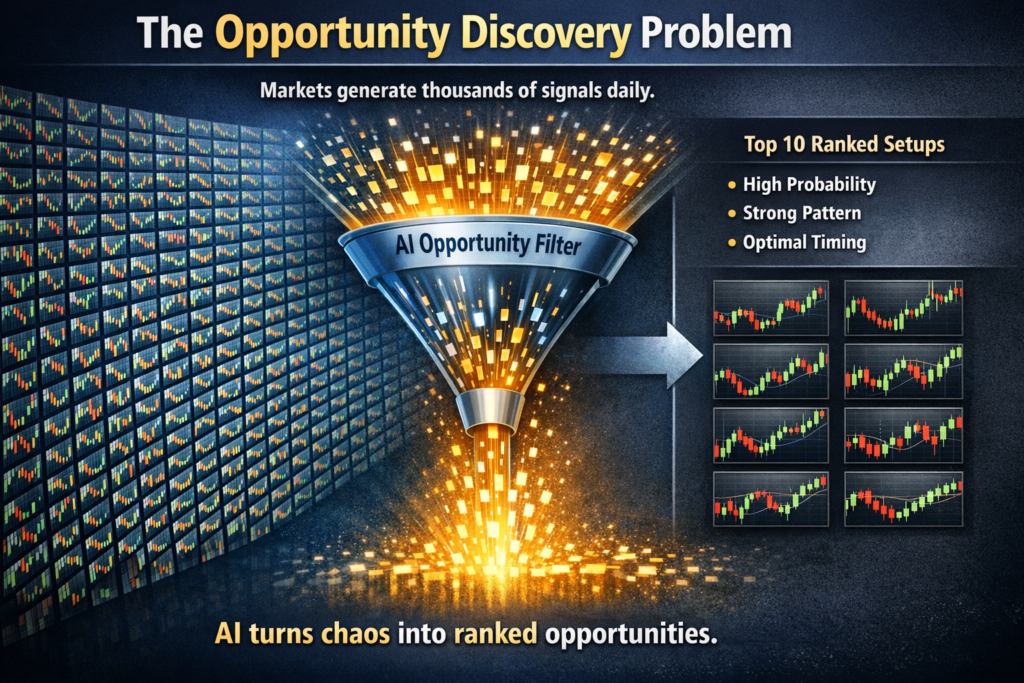
Because markets produce thousands of potential signals every day.
Stocks.
Options.
Crypto pairs.
Forex markets.
Indices.
Across multiple timeframes.
Yet most traders are manually scrolling through charts like someone flipping TV channels.
This is where the real bottleneck hides.
A Small Experiment That Revealed Something Surprising
While experimenting with AI-assisted trading research tools, a fascinating pattern appeared.
Two traders were given:
• the same strategy
• the same market
• the same timeframes
On paper, their performance should have been identical.
But it wasn’t.
The difference was dramatic.
One trader consistently found higher quality setups.
The other trader missed many opportunities.
Their profitability diverged significantly.
At first, the obvious assumption was:
Maybe one trader is simply more skilled.
But after analyzing the workflow, something else emerged.
The real difference had nothing to do with strategy.
It had everything to do with how they discovered opportunities.
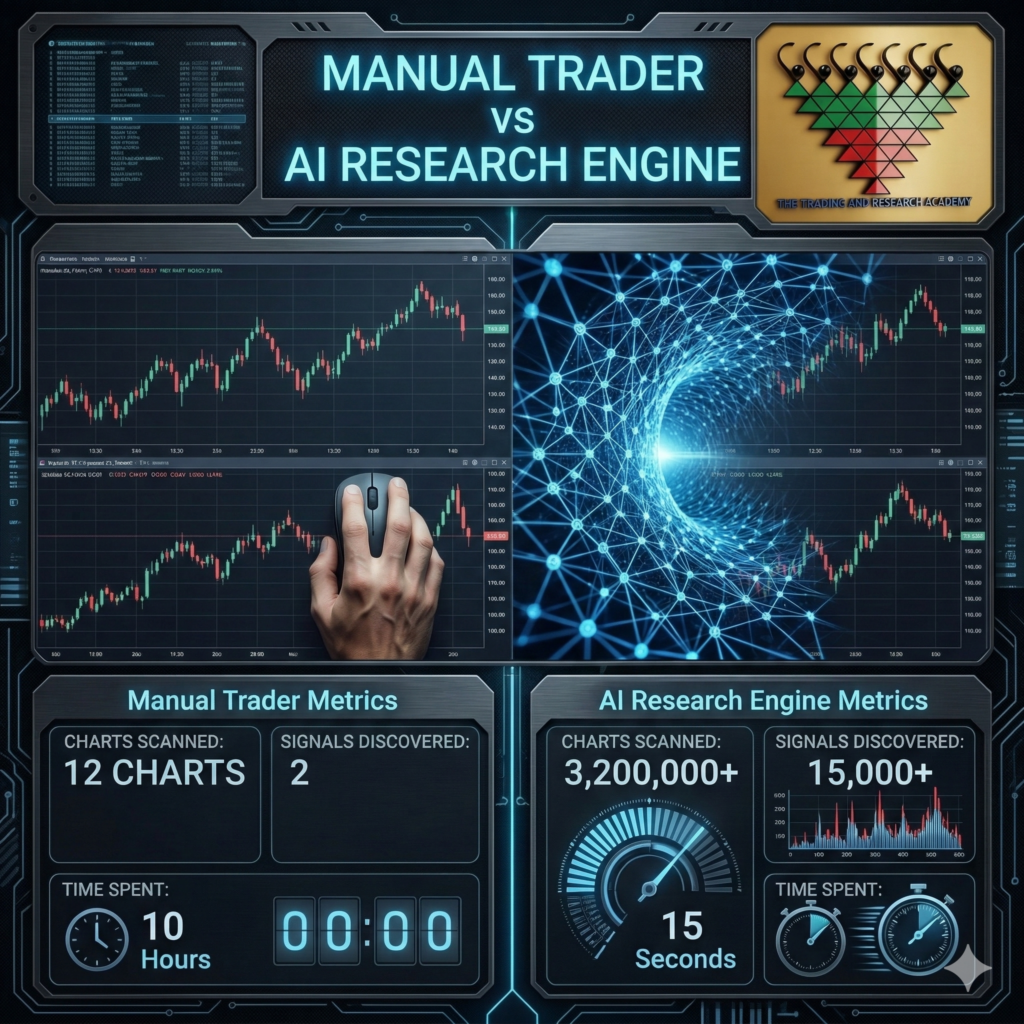
Trader #1: The Manual Research Workflow
The first trader followed a workflow most retail traders use.
It looked something like this:
Open charting platform.
Scan symbols manually.
Check indicators.
Look for patterns.
Repeat.
On average, this trader could scan about 50–60 charts per day.
Even with strong discipline and experience, the process remained slow.
Typical manual workflow:
Charts scanned → 60/day
Signals discovered → random
Time spent → ~3 hours
The result?
Opportunity discovery was largely limited by human bandwidth.
This is not a strategy limitation.
It’s a research capacity limitation.
Trader #2: The AI-Assisted Research Workflow
The second trader used an AI-powered scanning system.
Instead of manually browsing charts, the system continuously analyzed market data.
It automatically:
• scanned thousands of symbols
• detected predefined patterns
• ranked potential trade setups
The trader only reviewed the highest probability opportunities.
The workflow looked very different.
Market Data
↓
AI Pattern Scanner
↓
Signal Ranking Engine
↓
Trader Review
↓
Execution
Typical AI-assisted workflow:
Charts scanned → 8000/day
Signals found → ranked
Time spent → ~3 minutes
The difference was not subtle.
It was massive.
The AI system effectively functioned as a 24/7 research analyst.
The Real Bottleneck in Trading
Most traders assume the bottleneck is signal accuracy.
But in many cases, the real bottleneck is signal discovery.
Imagine two fishermen.
Both have identical fishing rods.
But one fishes in a small pond.
The other fishes in the entire ocean.
Who will find more opportunities?
Markets work the same way.
The trader who can scan more opportunities faster gains a structural advantage.
Not because they are predicting better.
But because they are searching smarter.
Why Research Infrastructure Matters More Than Indicators
Professional hedge funds rarely rely on a single indicator.
Instead, they invest heavily in research infrastructure.
This includes:
• data pipelines
• pattern detection systems
• signal ranking algorithms
• automated scanning tools
Because they understand a fundamental truth:
The best strategies are useless if you cannot discover opportunities efficiently.
This is similar to scientific research.
A lab with advanced instruments will make discoveries faster than one relying on manual observations.
Trading is no different.
How AI Is Transforming Trading Research
Artificial intelligence dramatically expands what traders can analyze.
Instead of scanning dozens of charts, AI can process thousands simultaneously.
This creates three major advantages.
1. Removing Emotional Bias from Trade Selection
Manual chart scanning introduces subtle psychological biases.
Traders may:
• ignore setups after a losing streak
• favor familiar symbols
• hesitate during volatile periods
AI systems evaluate signals purely based on defined criteria.
They do not experience fear or hesitation.
This leads to more consistent opportunity discovery.
2. Detecting Patterns Humans Miss
Human pattern recognition is powerful.
But it is also limited.
When markets generate massive amounts of data, many patterns remain hidden.
AI can analyze:
• multi-timeframe structures
• historical pattern clusters
• statistical anomalies
These patterns may never appear during manual chart browsing.
This dramatically increases signal discovery depth.
3. Ranking Opportunities Before Execution
Perhaps the most powerful feature of AI-assisted research is signal ranking.
Instead of treating all setups equally, the system scores opportunities based on probability.
This allows traders to prioritize:
• highest probability setups
• strongest pattern confirmations
• optimal timing windows
The trader’s attention shifts from searching for trades to evaluating the best trades.
4. Increasing Research Speed
Speed is one of the most underestimated advantages in trading.
Markets evolve quickly.
Opportunities appear and disappear within minutes.
Manual research simply cannot keep up with this pace.
AI dramatically accelerates the research process.
What once required hours can now be completed in seconds.
A Shift From Strategy Thinking to System Thinking
This is where many traders experience a mental shift.
Instead of asking:
“What is the best indicator?”
They begin asking:
“How do I build a better research system?”
This shift transforms trading from a signal-hunting activity into a research engineering discipline.
The trader becomes less like a chart watcher and more like a system designer.
The Rise of the Research-Driven Trader
The next generation of traders will likely operate differently from traditional discretionary traders.
They will rely on tools that combine:
• AI scanning engines
• automated pattern detection
• statistical ranking systems
• workflow automation
Their role will not disappear.
But it will evolve.
Instead of spending hours searching for setups, they will spend time:
• validating signals
• refining research rules
• designing better trading systems
In many ways, the trader becomes a research architect.
The Myth of the Perfect Indicator
The trading world often sells a seductive idea.
That somewhere out there exists a perfect indicator.
A magical tool that can consistently predict market direction.
But markets are too complex for simple formulas.
Indicators are only one layer of the trading process.
Without strong research infrastructure, even the best indicators struggle to produce consistent results.
The truth is much less glamorous but far more powerful.
Better research systems produce better opportunities.
And better opportunities lead to better trades.
What This Means for Individual Traders
You don’t need a hedge fund budget to benefit from this shift.
Even small improvements in research workflow can create significant advantages.
Traders can begin by asking simple questions:
• How many charts do I analyze daily?
• How long does opportunity discovery take?
• Am I relying entirely on manual scanning?
Even modest automation can dramatically increase research capacity.
The goal is not to eliminate human judgment.
The goal is to augment human intelligence with better systems.
The Future of Trading Research
The next decade will likely see rapid innovation in trading infrastructure.
AI will increasingly assist traders with:
• opportunity detection
• pattern recognition
• statistical signal ranking
• research automation
As these tools become more accessible, the competitive edge will shift again.
It will move toward traders who understand how to design effective research workflows.
Not just those who memorize indicator settings.
A New Type of Trader Is Emerging
Imagine a trader starting their day.
Instead of manually scrolling through hundreds of charts, they open a dashboard.
The system has already analyzed the market overnight.
It highlights the top-ranked opportunities.
The trader reviews a curated list of potential setups.
Within minutes, they know where the most promising opportunities exist.
This is not science fiction.
It is the natural evolution of trading research.
The Big Takeaway
Most traders are optimizing the wrong thing.
They optimize indicators.
But the real edge lies in research infrastructure.
Because the biggest advantage in markets often comes from discovering better opportunities faster.
Better indicators might improve a signal slightly.
But better research systems transform the entire trading process.
And that changes the game.
A Question Worth Thinking About
As AI continues to reshape trading research, an interesting question emerges.
Will the traders of the future spend more time trading…
Or designing intelligent research systems?
In many ways, the role of the trader may start to resemble that of a system architect.
And like any great Bollywood story, the plot twist arrives when you least expect it.
Because in the markets…
the real edge might not be strategy at all.
It might be the system behind it.